Navigating AI Safely: A Practical Guide for Small Businesses
· Rafael Cortes · 4 min read
Learn how your small business can embrace AI tools for productivity without accidentally leaking sensitive customer data or company secrets.
Artificial Intelligence (AI) is no longer just for big tech companies. Tools powered by AI are becoming increasingly accessible and useful for small businesses, offering new ways to boost productivity, spark creativity, and streamline operations. From generating marketing copy to assisting with customer service, the potential is exciting.
However, with this powerful new technology comes a critical consideration for SMB owners: data privacy and security. The way you and your team use AI tools can inadvertently expose sensitive business information, including customer data or proprietary company secrets. This isn't about avoiding AI; it's about using it smartly and securely.
The Promise and Pitfalls of AI for SMBs
For small businesses, AI can feel like having an extra team member. It can draft emails, summarize documents, brainstorm ideas, and even help analyze sales trends. These capabilities can save valuable time and resources, allowing you to focus on core business activities.
But here's the catch: many popular AI tools, especially free or consumer-grade versions, operate by learning from the data they process. When you input information—whether it's an internal report, customer feedback, or a draft contract—that data might be used to train the AI's underlying models. This means your private business data could, theoretically, become part of the AI's general knowledge base and potentially surface in responses to other users' queries.
This risk is particularly high with "public" AI models. While some enterprise-level AI solutions offer "private workspaces" or guarantee data isolation, it's crucial for SMBs to understand the default behavior of the tools they use. Not all AI is created equal when it comes to data handling.
Practical Steps for Secure AI Use
Using AI doesn't have to be a gamble. By implementing a few straightforward practices, you can harness its benefits while safeguarding your business's sensitive information.
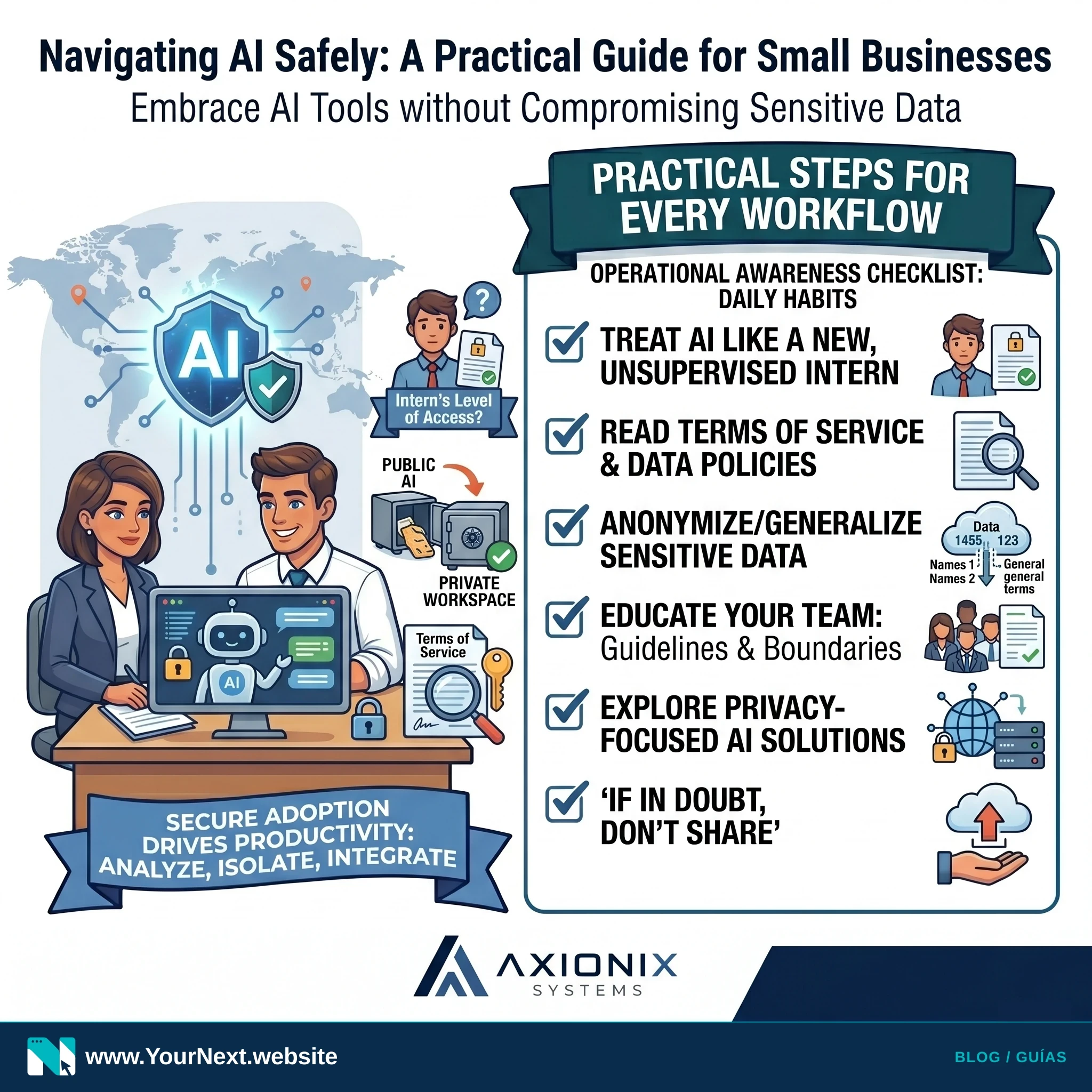
- Treat AI Tools Like a New Employee: Before sharing any information with an AI, ask yourself: would I trust this information with a brand-new, unsupervised intern? What level of access would I give them? This mindset helps you critically evaluate what data is appropriate to share.
- Read the Terms of Service and Privacy Policies: It might seem tedious, but this is where companies explain how they use your data. Look for clauses about "input data," "model training," and "data retention." If a tool doesn't explicitly state that your input data is private and not used for training, assume it's public.
- Anonymize or Generalize Sensitive Data: If you need AI to process customer feedback, internal reports, or contract drafts, remove all personally identifiable information (PII) like names, addresses, account numbers, and any unique business identifiers before inputting. Generalize the information as much as possible while retaining the context you need.
- Educate Your Team: Your employees are your first line of defense. Provide clear guidelines on what kind of information can and cannot be entered into AI tools. A simple "if in doubt, don't share" rule can go a long way.
- Explore Privacy-Focused AI Solutions: As AI technology evolves, more business-oriented tools are emerging that prioritize data privacy. These might offer features like encrypted data handling, private instances, or explicit guarantees that your data won't be used for model training.
Your AI Safety Actions This Week
- Audit Current AI Use: Identify all AI tools currently being used by you and your team (e.g., ChatGPT, Bard, Midjourney, AI features in Microsoft 365 or Google Workspace).
- Review Data Policies: For your top 2-3 most used AI tools, quickly review their privacy policies regarding input data and model training.
- Create a Simple Internal Guideline: Draft a one-paragraph rule for your team, e.g., "Do not enter customer names, addresses, financial data, or proprietary company secrets into public AI tools."
- Communicate with Your Team: Share your new guideline and discuss the importance of responsible AI use in a brief meeting or email.
- Pilot a Privacy-Focused Tool: If a specific business function could greatly benefit from AI, research and consider trying a business-grade AI tool with strong privacy guarantees.
AI is a powerful ally for small businesses, but like any powerful tool, it requires careful handling. By understanding how these tools work and setting clear boundaries for their use, you can confidently integrate AI into your operations without compromising your data or your customers' trust.
Axionix Systems can help. We help small businesses use practical tools safely, including safe AI workflows, data privacy basics, and employee cybersecurity awareness training. Contact us at axionixsystems.com.