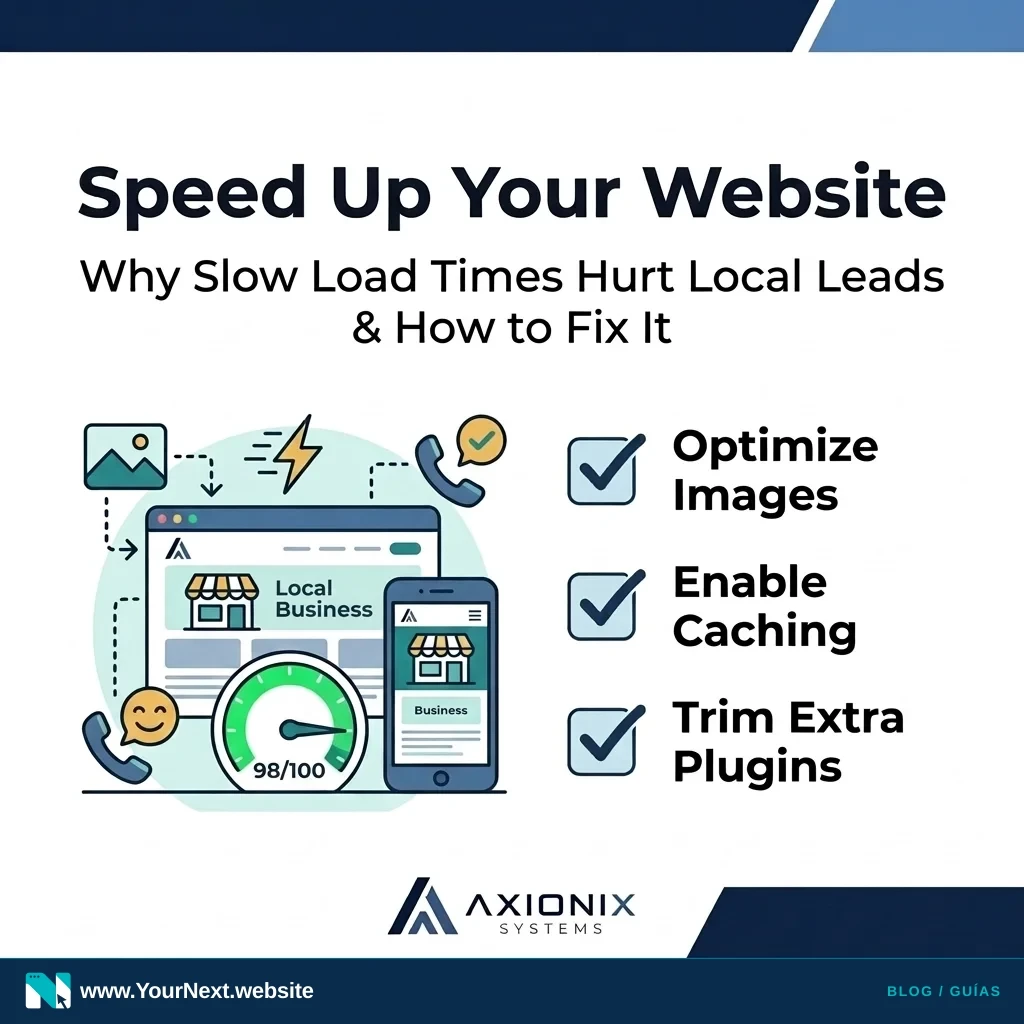
In today's fast-paced world, attention spans are shorter than ever. For small and medium businesses—especially those relying on local customers—a slow-loading website isn't just an inconvenience; it's a silent killer of leads and sales. Imagine a potential customer searching for your services on their phone while on the go. If your site takes more than a few seconds to appear, they're likely to hit the back button and call a competitor.
The Hidden Costs of a Sluggish Site
A slow website impacts your business in several ways that might not be immediately obvious from a quick glance at your homepage.
First, customer patience on mobile: Studies consistently show that most visitors expect a web page to load in under 2 to 3 seconds. Beyond that threshold, bounce rates (visitors leaving your site before taking action) skyrocket. For local businesses, this means someone searching for "plumber near me" or "best coffee shop downtown" on a cellular connection is just one tap away from choosing a faster competitor.
Second, search engine ranking and local visibility: Google and other search engines measure real-world page speed and responsiveness (known as Core Web Vitals) when ranking websites. If your pages load slowly or shift around while rendering on mobile devices, it can hurt your visibility in local search results and make it harder for nearby customers to find you organically.
Third, user experience and first-impression trust: A sluggish website feels outdated and neglected, eroding confidence before a prospect even reads about your services or reaches your contact form. Fast, responsive pages quietly signal reliability and professionalism.
Practical Steps You Can Take Today
Improving your website's speed doesn't always require starting from scratch, though replacing an aging theme often helps. Here are five high-impact steps you can take to eliminate common bottlenecks:
Your Website Speed Action Checklist
- Optimize Images: Oversized, uncompressed photos are the single most common culprit behind slow websites. Compress images before uploading to reduce file size without sacrificing visual clarity, and use modern formats like WebP whenever possible.
- Enable Browser Caching: Caching stores reusable parts of your website (such as your logo, fonts, and stylesheets) on a visitor's device after their first page view, so subsequent pages and repeat visits load almost instantly.
- Minimize Unnecessary Plugins and Scripts: If you use a platform like WordPress or a heavy page builder, audit your installed plugins. Deactivate and delete any you don't actively need. Every extra plugin and third-party script (like old tracking pixels or chat widgets) adds code that slows down page rendering.
- Review Your Hosting Plan: Sometimes the bottleneck isn't your page design, but the server hosting it. Budget shared hosting plans crowd hundreds of websites onto the same server, slowing down initial response times during busy hours. Consider upgrading to a modern managed or edge-hosted platform.
- Use a Content Delivery Network (CDN): Even for local businesses, a CDN (such as Cloudflare) speeds up delivery by serving cached copies of your website from high-speed regional edge servers close to your customers, offloading work from your main server and keeping mobile load times snappy.
Want a clearer view of your website’s performance? Request a website review from Your Next Website.
Taking these practical steps will noticeably improve how your website feels on smartphones and desktops alike—leading to lower bounce rates, stronger local search visibility, and more customer inquiries.
If slow pages are getting in the way of customer inquiries, discuss a website rebuild with Your Next Website. Explore a managed site with performance and ongoing maintenance in mind.